
Why Small Rituals Matter More Than We Think
A few years ago, I would have rolled my eyes at the phrase “romanticize your life.”
It sounded like something you’d find written over a perfectly curated photo on social media. A trendy phrase attached to aesthetic videos of people pouring coffee into handmade mugs or arranging flowers in sunlit kitchens.
But the older I get, the more I think the idea has been misunderstood. Romanticizing your life isn’t about pretending everything is beautiful.
It’s about noticing that some things already are.
Somewhere along the way, many of us began treating ordinary life as something to get through rather than something to experience. We rush through breakfast while checking emails. We save the good dishes for guests. We postpone celebrations until a future milestone arrives. We tell ourselves we’ll slow down later, enjoy life later, wear the jewelry later, travel later.
Meanwhile, entire seasons quietly pass us by.
Perhaps that is why the concept of romanticizing everyday life resonates with so many people right now. Not because life suddenly became easier, but because it became busier, louder, and more distracting. We are surrounded by endless information and constant demands for our attention, yet many people feel increasingly disconnected from their own lives.
The desire to romanticize everyday life is often less about aesthetics and more about presence. It is the decision to participate in your own life rather than simply manage it.
The Beauty of Ritual
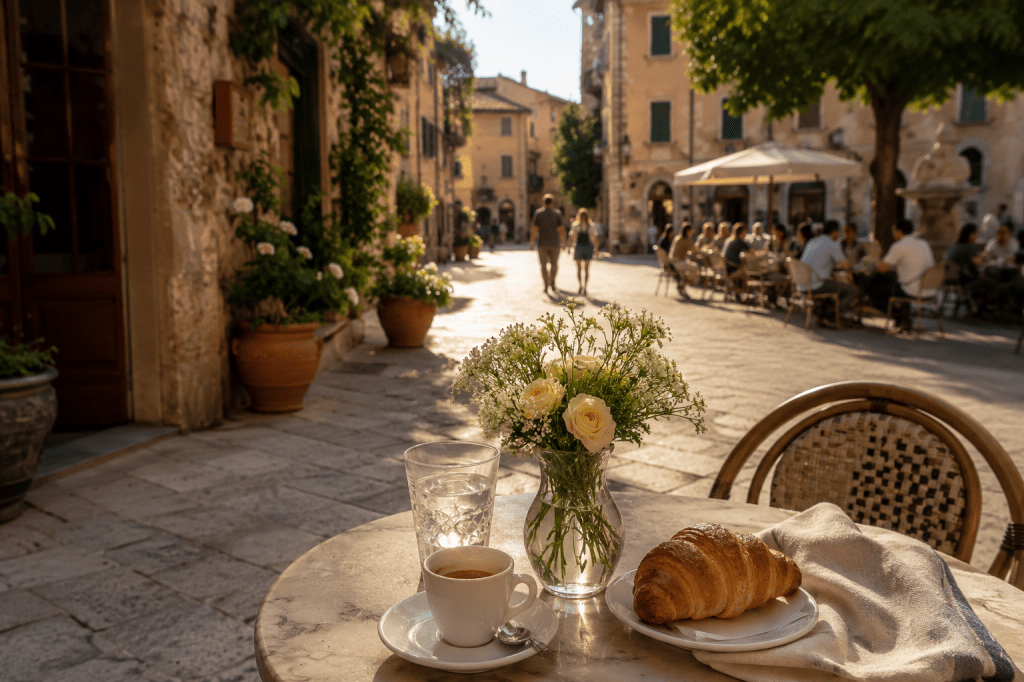
One thing Italian culture has always understood particularly well is the importance of ritual. Not grand ceremonies. Small ones.
Perhaps what Italian culture understands especially well is that life’s small pleasures are often meant to be shared.
The morning espresso at the neighborhood caffè is rarely just about the coffee. It’s about seeing familiar faces, exchanging greetings, and feeling connected to a community. The evening passeggiata through town isn’t simply a walk; it’s an opportunity to stop and chat with neighbors, admire a friend’s new baby, or catch up with someone you haven’t seen in a while.
Even meals, which are often celebrated as a cornerstone of Italian culture, are rarely rushed or eaten in isolation. Food becomes a reason to gather, to linger, to tell stories, and to strengthen relationships.
Perhaps this is why so many of these traditions feel romantic. They remind us that a beautiful life is not built solely from personal rituals, but from shared experiences.
The coffee tastes better when it’s enjoyed with conversation. Dinner feels richer when the table is full. An evening walk becomes more meaningful when someone walks beside you.
At its heart, the Italian art of living is not just about slowing down. It’s about slowing down together.
These rituals may appear insignificant from the outside, but they create rhythm. They become the markers that help us experience life more fully and the moments we remember long after they have passed.
The smell of coffee in the morning. A candle lit during dinner. A familiar gathering around the table with fresh cut flowers at the center. Repeated often enough, these small moments create a sense of comfort, belonging, and continuity.
They make a life feel lived.
Why We Save Beautiful Things for Later
Perhaps one of the strangest habits many of us have developed is saving beautiful things for a future occasion.
The dress hangs unworn in the closet. The perfume stays on the shelf. The nice dishes remain tucked away in a cabinet. The jewelry is reserved for special events. As if ordinary days have not earned beauty.
But what if we have it backwards? What if beauty is most needed on ordinary days?
A Tuesday afternoon may never become a cherished memory because of what happened. But it might become memorable because of how it felt.
The sunlight through the window. The flowers on the counter.
The favorite necklace worn for no reason at all.
These details do not change our circumstances. They change our experience of them.
A Softer Way of Living
At its heart, romanticizing everyday life is really about paying attention.
Not in a dramatic way, but in the quiet ways that often go unnoticed. Paying attention to the changing seasons. To the people sitting across the table from us. To the routines that shape our days and the small pleasures that are often overlooked in the rush to get to whatever comes next.
It is not about creating a perfect life. It is about becoming more present within the life you already have.
The Italian philosophy of La Dolce Vita has never been about luxury in the traditional sense. It is not rooted in extravagance or excess, but in the belief that life becomes richer when it is fully experienced. A simple meal shared with family. A conversation that lingers long after the plates have been cleared. An evening walk through town as neighbors gather outside to enjoy the cooling air.
What makes these moments meaningful is not necessarily what is happening, but the attention we give them. They ask us to slow down enough to notice what might otherwise pass us by.
There is something deeply comforting about that idea, especially in a world that constantly encourages us to focus on the next task, the next goal, or the next destination. We spend so much time looking ahead that we sometimes forget to fully inhabit the moments already unfolding around us.
Perhaps that is why the idea of romanticizing everyday life resonates so strongly today. It reminds us that joy is rarely found in some distant future version of life. More often, it is found in the ordinary moments we learn to appreciate while they are still happening.
Inspired by the Italian Art of Living
At Via Limoncella, so much of our inspiration begins with the belief that everyday life deserves beauty.
Not because life is always easy or picturesque, but because beauty has a way of grounding us in the present moment. It invites us to slow down, pay attention, and find meaning in things we might otherwise overlook.
Sometimes that beauty is found in a favorite coffee cup used every morning. Sometimes it is fresh flowers on the kitchen counter, a family dinner that stretches longer than expected, or a piece of jewelry worn not for a special occasion, but simply because it brings a little joy to an ordinary day.
These things may seem small, but they are often the details that become woven into our memories. They shape the atmosphere of our lives and help transform routine into ritual.
Perhaps romanticizing everyday life is not about creating something new at all. Perhaps it is simply learning to recognize the beauty, connection, and meaning that have been there all along.
 Via Limoncella
Leave a comment